The Bavarian Arts and Crafts Association’s (BKV) retail store and gallery, along with the Galerie Handwerk, are of central importance to the arts and crafts sector—far beyond Munich and its borders. Now, the BKV’s board of directors has announced the closure of the premises “with great regret.” The exhibition planned for July to mark the association’s 175th anniversary, as well as all exhibitions scheduled for the fall, have been canceled.
The reason is the store’s financial losses. “This was a very difficult decision for the board,” says Bernd Traut, outgoing chairman of the BKV. “While the store’s sales have remained stable in recent years, personnel and energy costs have risen significantly. Despite our loyal customer base, consumer behavior regarding high-quality artisanal products has fundamentally changed. A reversal of this trend is not currently expected. Consequently, the retail store cannot be operated on a self-sustaining basis for the foreseeable future.”
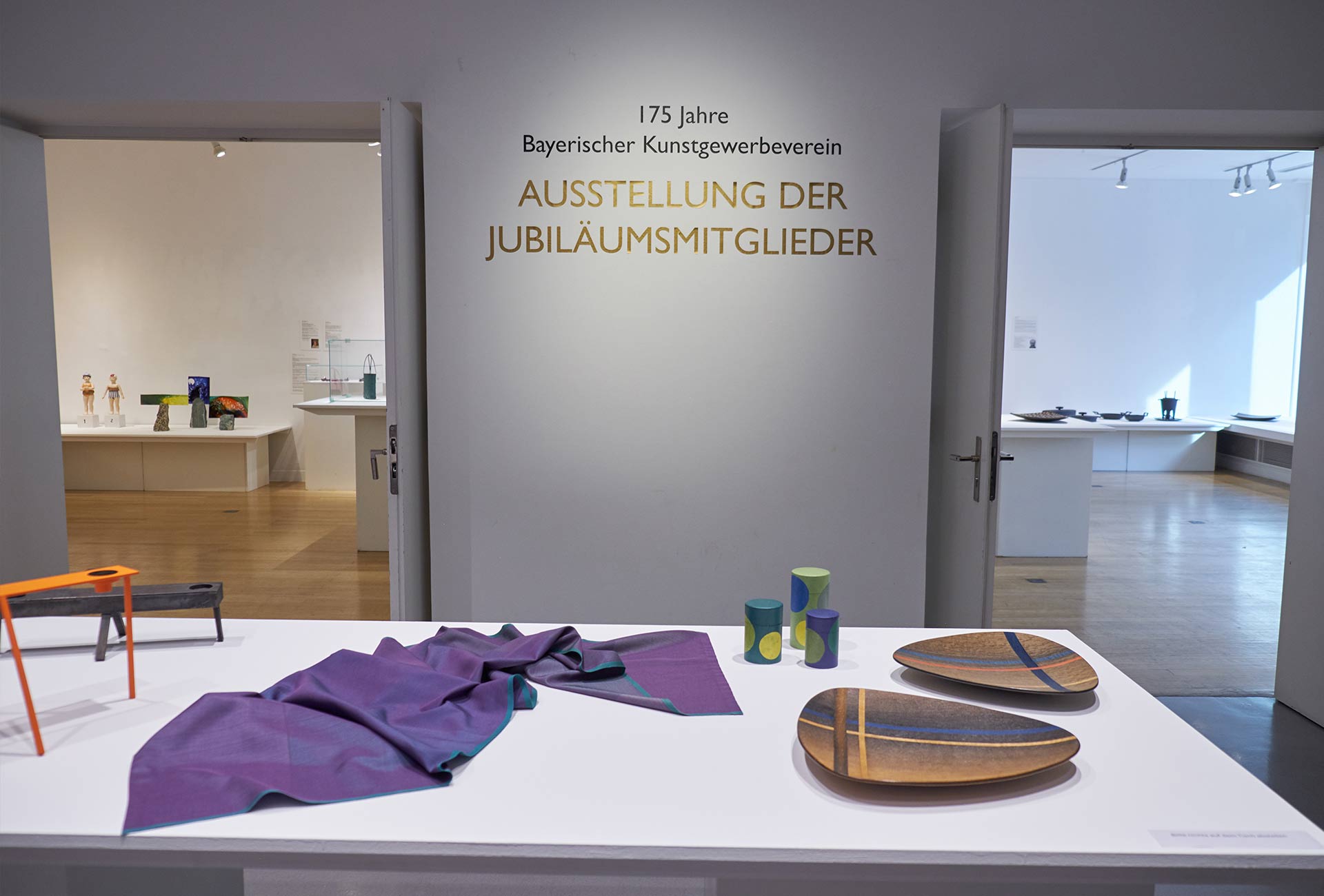
One of the most recent exhibitions at the gallery of the Bavarian Arts and Crafts Association on Pacellistraße, near the Bayerischer Hof. © Ulrich Sanberger.
The Bavarian Arts and Crafts Association is recognized as a nonprofit organization. It is financed largely by rental income from an office building owned by the association. However, as a fiscally independent business entity, the retail store does not fall under the nonprofit sector. Its losses may therefore not be offset with funds from the nonprofit association. The adjacent Gallery of Applied Arts is part of the association’s nonprofit sector. Nevertheless, the association has decided to temporarily close it as well. The personnel resources thus freed up are to be used to develop a new, sustainable overall concept for the store and the gallery.

Visitors in the BKV gallery in front of a display case featuring bags by Maria Verburg. © Ulrich Sanberger.
According to reports from Munich, the reopening of the gallery spaces is clearly the top priority. As one of the few opportunities for artisans to present their work to the public in a high-quality setting, the BKV gallery serves as a stage and flagship for Bavarian arts and crafts. “We believe that a gallery is an essential part of the Bavarian Arts and Crafts Association. It makes the association an important destination far beyond Munich and Bavaria. Here, people can see what Bavarian arts and crafts have to offer; here, conversations take place not only among artisans themselves but also with collectors, customers, and interested parties from all over the world,” says Bernd Traut. “Arts and crafts that can no longer be seen anywhere have no future.”
Bernd Traut Steps Down as Chairman
As part of the association’s realignment, Bernd Traut is stepping down from his position as 1st Chairman effective June 30. “I have served on the BKV’s board for a total of 18 years. The association has grown very dear to my heart over all these years. My resignation is certainly not due to a lack of commitment, but rather out of an awareness of the responsibility that comes with this office. I thank everyone who has supported and stood by the BKV for their collaboration, and I wish the association all the best for the decisions and developments ahead.”
The association will be represented by Nicole Schuster and Christine Demmel, the former vice chairs. “In the 175 years since its founding, the Bavarian Arts and Crafts Association has had to overcome many hurdles. Now, once again, it is time to reevaluate the status quo and adapt our structures to current economic and social conditions,” said Nicole Schuster.
History and Mission of the BKV
The Bavarian Arts and Crafts Association was founded in 1851 with the goal of promoting training and quality in craft design. Facilitating exchange among designers, raising public awareness of arts and crafts, and supporting continuing education and the next generation of artists also play a central role. Since 1878, the association has been headquartered at Pacellistraße 6–8 in Munich. The association’s headquarters, spanning approximately 300 m², houses not only the administrative office but also a retail store and a gallery for applied arts, where eight rotating exhibitions are held annually, featuring works in fields such as jewelry, ceramics, glass, metal, wood, textiles, and paper. The association currently has more than 400 members, who are selected by a panel of experts.