Historically speaking, hardly any city is better suited to present the 15th Danner Prize: it was in Nuremberg that Albrecht Dürer became the world-famous artist of the Renaissance. Veit Stoss, the outstanding sculptor and woodcarver of the Late Gothic period, left the city major works such as the Angelic Salutation, and Hans Sachs, a shoemaker by trade, shaped its literary life as a Meistersinger and poet. The exhibition at the Neues Museum impressively documents how the relationship between art and craft, gradually redefined during the Renaissance, is being renegotiated half a millennium later. For alongside fine craftsmanship, the exhibition features quite a few works that meet every standard of fine art.
The Danner Foundation awards its prize for crafts every three years. Nearly 300 applicants submitted their work. In addition to the five prizewinners, 46 others made it into the exhibition. That it is now being shown at the Neues Museum Nürnberg for the first time fits both the historical context and this development: the museum has fostered a dialogue between art and design – one that includes craft – from the very beginning. The building itself, with its 100-meter glass façade and striking spiral staircase, reflects this as well.
The presentation in the large exhibition hall of the central cube is convincing in itself. Isolde Bazlen, who has skillfully staged previous Danner Prize exhibitions, makes consistent use of the architecture of the square, seven-meter-high hall with its striking grid ceiling. Floor-to-ceiling fabric panels create calm, clearly defined areas, while pedestals and display cases follow the ceiling grid. In a cube at the center, portrait films introduce the prizewinners and their working methods. Video projections on three walls set individual works in motion – some enlarged or altered. “The room with its strict grid ceiling inspired me to deliberately set calm and movement against each other,” says the designer.

Floor-to-ceiling fabric panels in copper and deep violet structure the Danner Prize exhibition at the Neues Museum Nürnberg. Photo: Eva Jünger, © Danner-Stiftung.
An Oracle in Ceramics
Ute Kathrin Beck receives the Danner Prize, endowed with €20,000, for her sculptural ceramic work Orakel I. In ancient Greece, oracles were places of transition between the human and divine worlds. The sculpture, more than a meter tall, takes up this ambivalence: its powerful exterior appears concrete and tangible, while its seemingly otherworldly form and its interior, coated with a shimmering metallic luster glaze, remain enigmatic.
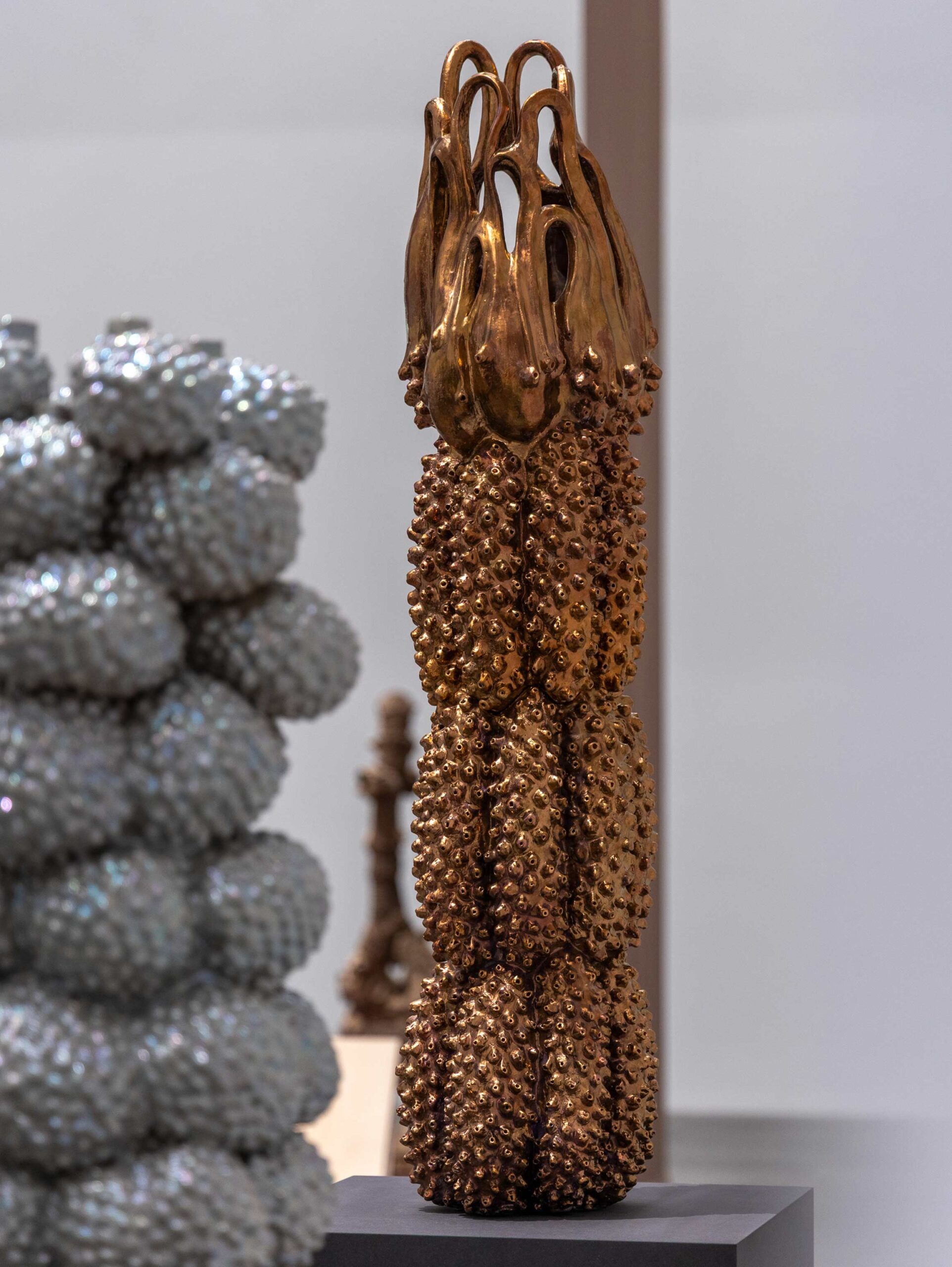
Ute Kathrin Beck receives the 2026 Danner Prize for her ceramic sculpture Orakel I, which stands more than a meter tall. Photo: Eva Jünger, © Danner-Stiftung.
Four Honorary Prizes
Honorary prizes of €5,000 each went to Markus Marschmann for his multimedia installation Apparat 987, Florian Clemens Meier for the installation Die Bausteine unserer Existenz (The Building Blocks of Our Existence), Sabine Steinhäusler for her brooch series Still, and Ayaka Terajima for her almost life-size ceramic object I looked up and she looked at me. The selection shows how naturally craft today moves between jewelry, sculpture, and installation.

Markus Marschmann received an honorary prize for his multimedia installation Apparat 987. Photo: © Markus Marschmann.

Sabine Steinhäusler’s brooch series Still was awarded an honorary prize. Photo: Eva Jünger, © Danner-Stiftung.
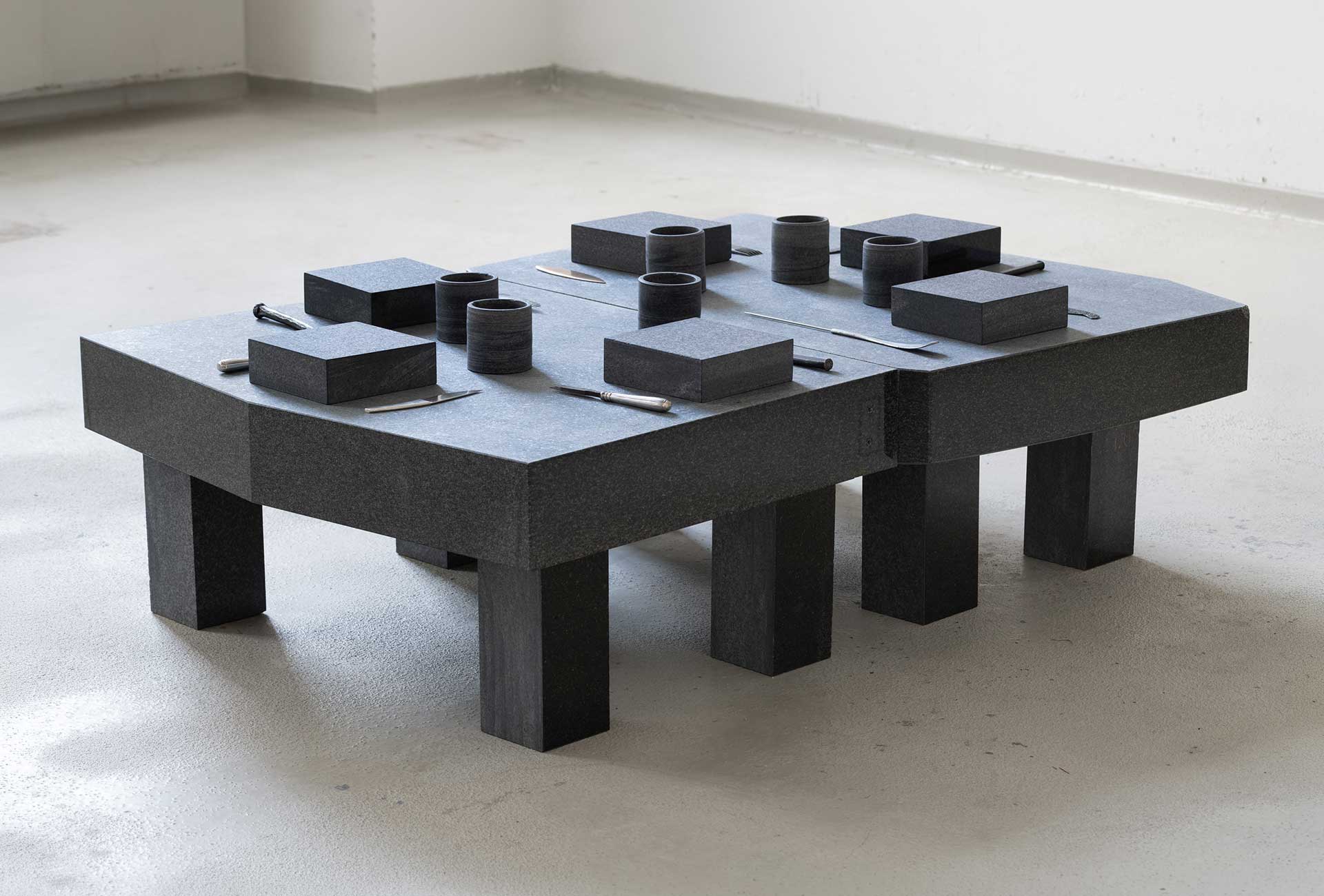
Florian Clemens Meier, Die Bausteine unserer Existenz, honorary prize 2026. Photo: © Alex Jeskulke.
A Counter-Model to Interchangeability
The prizes were decided by a nine-member expert jury that included Lilli Hollein, director general of the MAK Vienna, Olaf Thormann of the Grassi Museum Leipzig, and Nele van Wieringen of the Keramikmuseum Westerwald. For Markus Eder, executive chairman of the Danner Foundation, the award-winning works are “exclamation marks and a counter-model to a world of scalability, interchangeability, mediocrity, and monotony.” Lilli Hollein emphasizes how closely aesthetic and social questions are linked in applied art: it speaks “not only of forms and materials, but also of working conditions, resources, and production chains.”
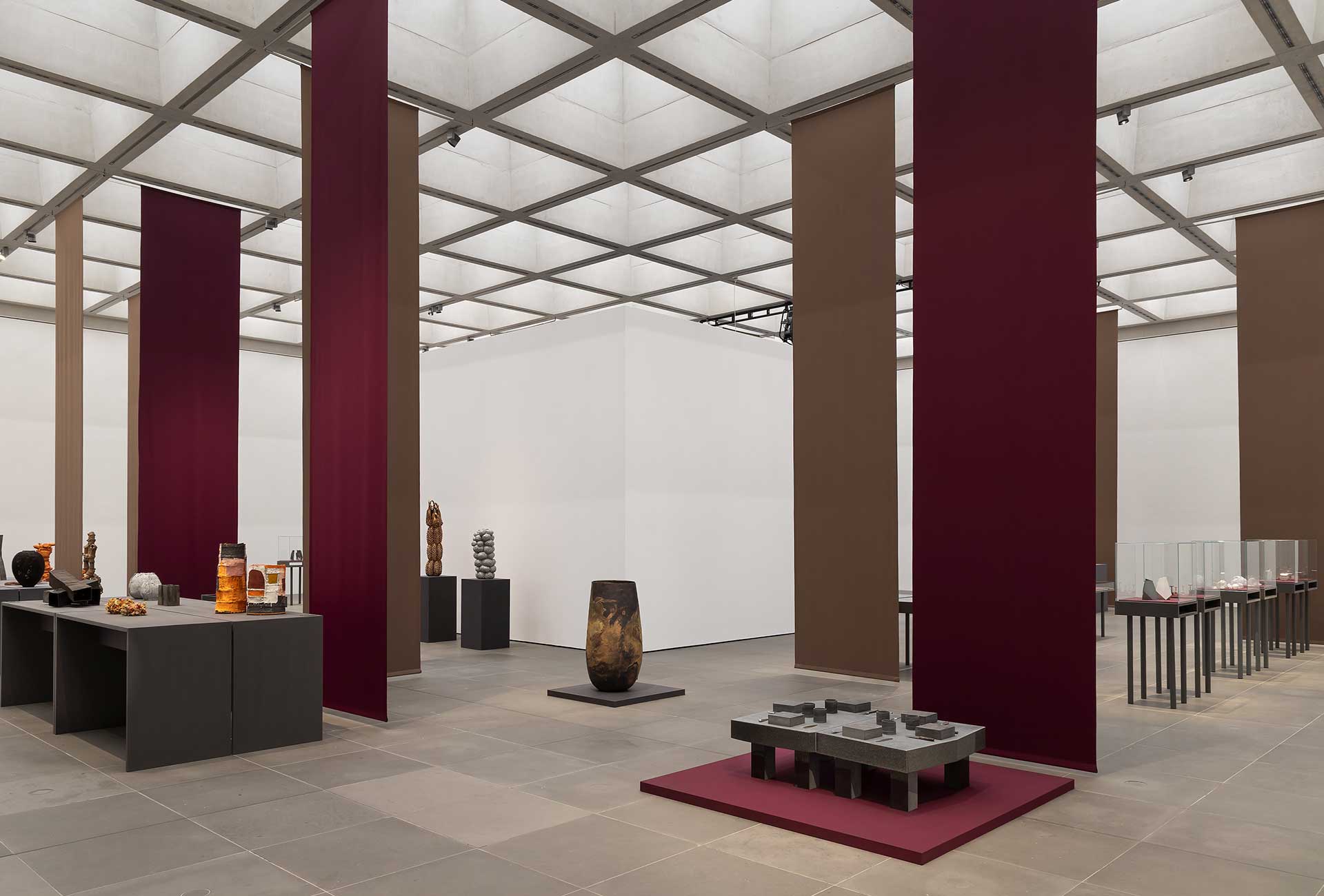
Pedestals and display cases are aligned with the ceiling grid. Photo: Eva Jünger, © Danner-Stiftung.
The Danner Prize has existed for 42 years. The foundation behind it was established as early as 1920 by Therese Danner to promote crafts in Bavaria, and above all young talent. A bilingual catalog of around 450 pages accompanies the exhibition, published by arnoldsche Art Publishers. A program of events invites visitors to explore contemporary craft in greater depth: guided tours every Sunday at 11 a.m., curator’s tours with Isolde Bazlen, for example on December 3 and 10, workshops, and a Danner Talk on January 26, 2027.
- —
-
Neues Museum Nürnberg
Klarissenplatz
90402 Nuremberg, Germany - Tue–Sun 10 a.m.–6 p.m., Thu 10 a.m.–8 p.m.
- Link