By rights, it should have disappeared long ago. Factories, assembly lines, and industrial robots could have driven the workshop out in the course of industrialization. Yet this space of Homo faber, the human being as maker, has weathered every storm of the past 250 years. More than that: in recent decades the workshop has experienced a worldwide renaissance – not so much as a rival to industry, but as an alternative wherever individuality, beauty, and sustainability matter. The winter issue of Art Aurea is devoted to this project for the future.
Workshop Stories from the Munich Academy of Fine Arts
Today there are more workshops than ever at vocational schools and art academies. Our author Ira Mazzoni visited four of the 22 workshops at the Munich Academy of Fine Arts. She found spaces that remain largely unnoticed by the public, yet are indispensable for bringing artistic ideas to life. Her article makes one thing clear: innovative contemporary art is hardly conceivable without well-equipped study workshops run with expertise and passion.

Study workshops are essential to the future of art, craft, and design. Shown here: the textile workshop at the Munich Academy of Fine Arts. Photo: Stephanie Rössing.
Simple Beauty: Youkyung Sin and Kiho Kang
Youkyung Sin and Kiho Kang came to Germany from South Korea 16 years ago. After studying ceramics in Seoul, they completed a master’s degree at the Institute for Artistic Ceramics and Glass of Koblenz University of Applied Sciences in Höhr-Grenzhausen and found a new home as a family in Bad Ems. Their ceramics are painstakingly hand-built – in a former metalworking shop that also has room for workshops. As Julie Metzdorf shows in her report, the two have never stopped experimenting and exploring.

Ceramic artists Youkyung Sin and Kiho Kang found a home for their workshop in a former metalworking shop in Bad Ems, Germany. © Kiho Kang.
Sharing a Workshop: Nicole Beck
Munich-based Nicole Beck shares her workshop with Christine Graf and Japanese-born Takayoshi Terajima. The three work in one room where each of them finds the calm needed to create art jewelry. Here, too, the workshop is both a place of production and a social space: you see what the others are working on, coordinate your schedules, and exchange ideas. And you are strengthened by the shared experience of making something by hand that has lasting cultural value.

Contemporary art jewelry is firmly rooted in Munich. Among its many protagonists is Nicole Beck. Photo: Ulrike Myrzik.
My Story, My Work
Two short portraits introduce artists and their life paths. Kinga Földi’s textile works are an expression of who she is. Yet they also speak of the essence of nature and its many forms – and offer an invitation to connect with others and with the world. For Flensburg ceramicist Gundula Sommerer, as for many artists, encounters with other cultures and the experience of living and working elsewhere have been formative.
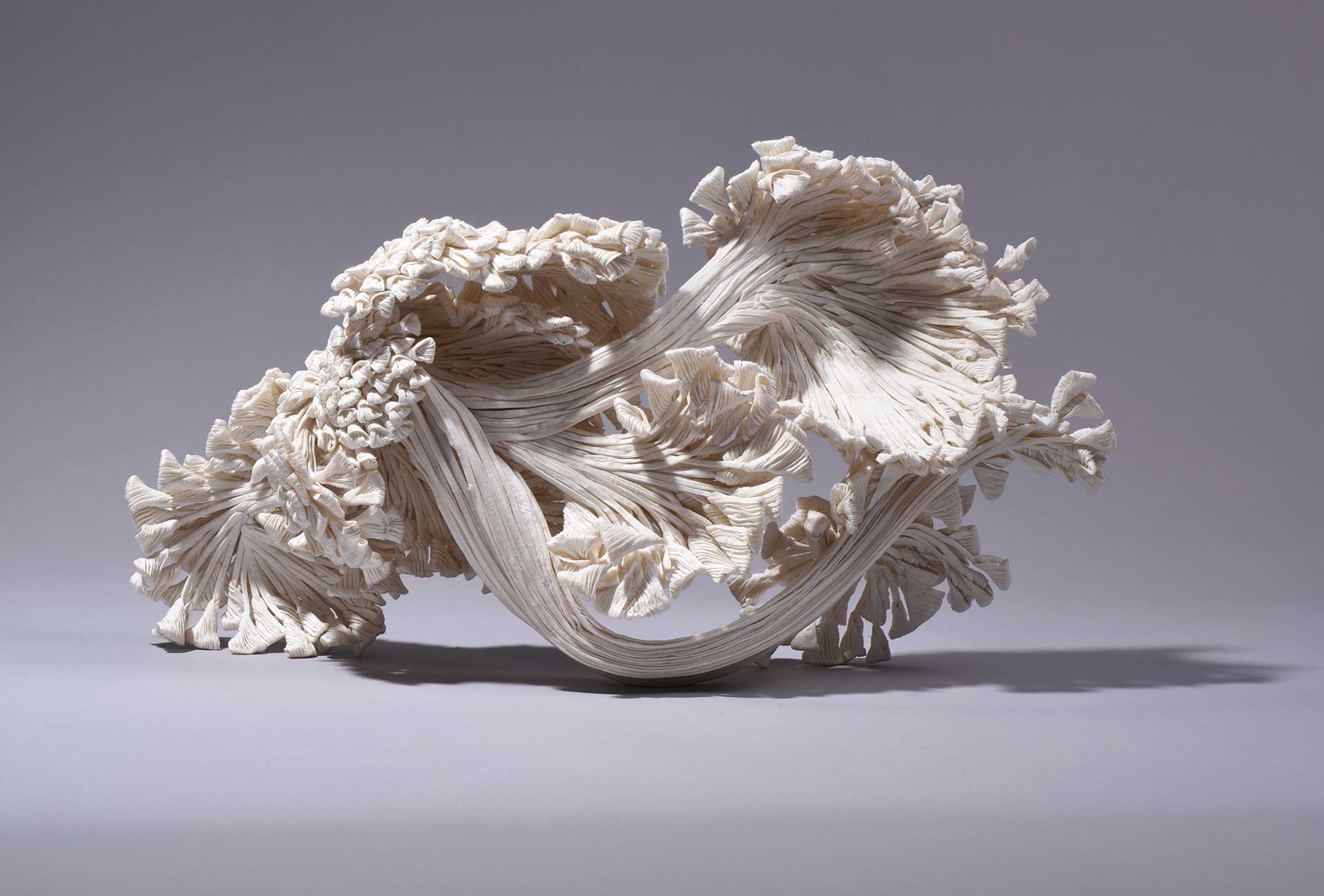
Kinga Földi’s silk sculptures grow out of a need to connect with the healing forces of nature. © Kinga Földi
Review
Cose della vita – The latest exhibition at Galerie Rosemarie Jäger in Hochheim brings together three very different artists – and yet there are many connections and commonalities to discover.
Places of Remembrance – In its Contemporary Craft series, the Museum für Kunst und Gewerbe Hamburg presents the first solo museum exhibition of the Ghanaian ceramic artist Kobina Adusah.
Art Jewelry in Brussels – With her Galerie Hectare, Lou Sautreau champions contemporary jewelry.
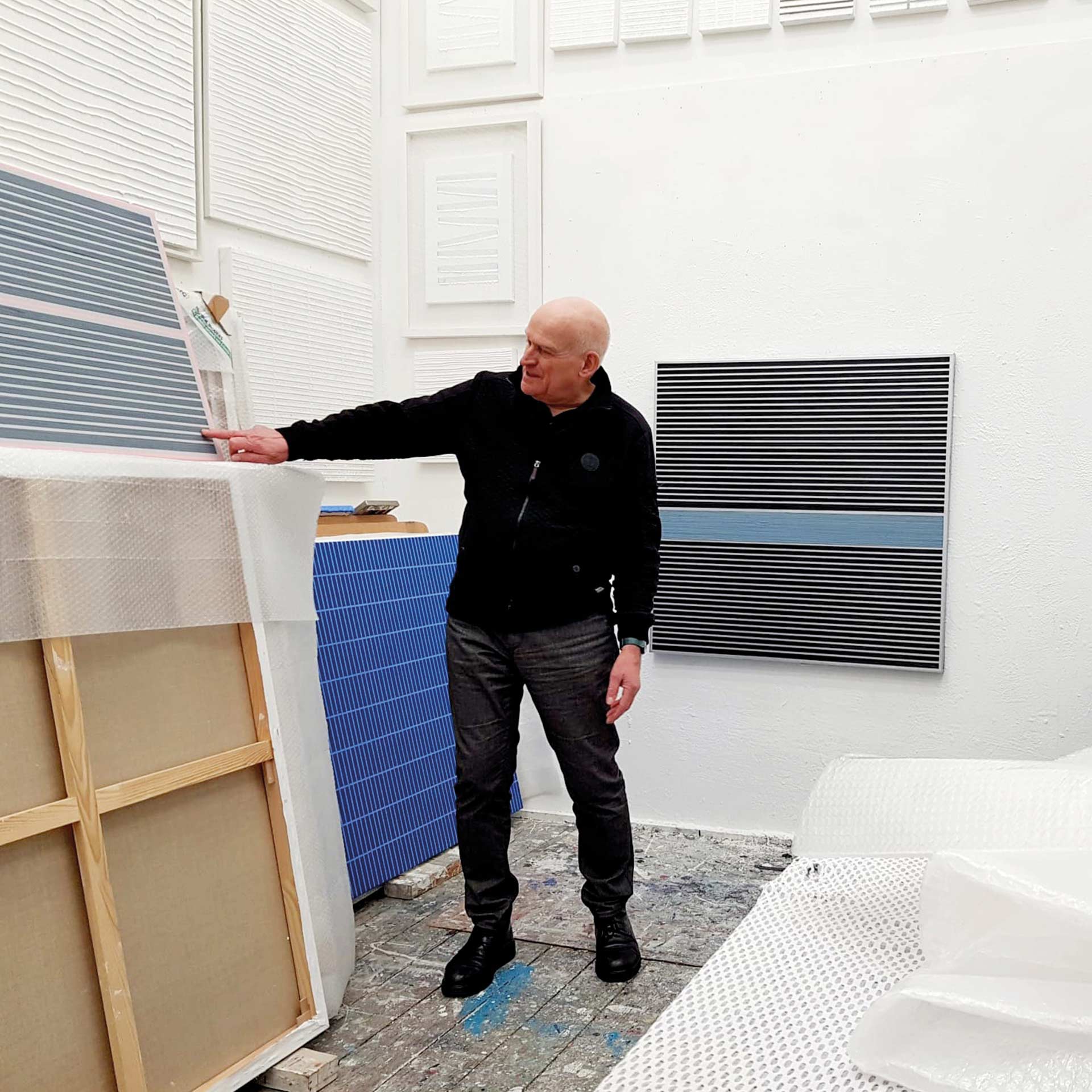
Erik Oldenhof at Hilde Leiss – The Amsterdam painter impresses with his radically reduced yet sensual abstraction.
Irina Razumovskaya – The Keramikmuseum Westerwald presents KORE, an exhibition by the winner of the Westerwald Prize.
Enameling and Becoming – A book about Nora Kovats’s work, exploring the interplay between craftsmanship and creative intuition.
Not a Nostalgic Counter-Model
The workshop, as every article in this issue shows, is not a nostalgic counter-model to industry. It is a place where unassuming people who strive for deeper meaning can flourish. Whether ambitious art is being created, something is being repaired, or solid craftsmanship is being practiced: every workshop holds its own distinct value for people and their culture. And it will outlast so-called artificial intelligence – or may even become more important because of it.
The winter issue of Art Aurea is available by subscription and from selected galleries and shops. Starting in 2027, Art Aurea will be published twice a year as a premium edition – the first to appear at the International Crafts Fair in Munich in March.