With a “landscape” of paintings and ceramic sculptures, the artist couple invites visitors to take a “stroll” through the spacious rooms of the former brewery courtyard.
In her ceramic work, Gudrun Petzold explores the constant changes in both organic and inorganic nature. She draws primarily from her observations of nature. “Yet her formal language is also characterized by a high degree of abstraction,” explains Berlin-based journalist Elfi Kreis. Seams, rough surfaces, and broken edges bear witness to the processes of transformation and change. Petzold’s selection of works in the Schöningen exhibition were inspired by formations from the region’s former open-pit coal mining and the artifacts on display at the nearby Paläon.

Gudrun Petzold, ceramic sculpture, 2026, fragmentary, 18.5 x 27.5 cm.
Double-walled forms, white-engobed and constructed in a spiral from narrow strips of clay, evoke glacial mills and vanishing glaciers. A small series of layered works also appears to have a mineral, geological origin; they are constructed cubically from fine strips of colored stoneware and accented with colored engobes. They evoke deposited layers of earth and rock but could also be of civilizational origin, uncovered by archaeological stratigraphy.
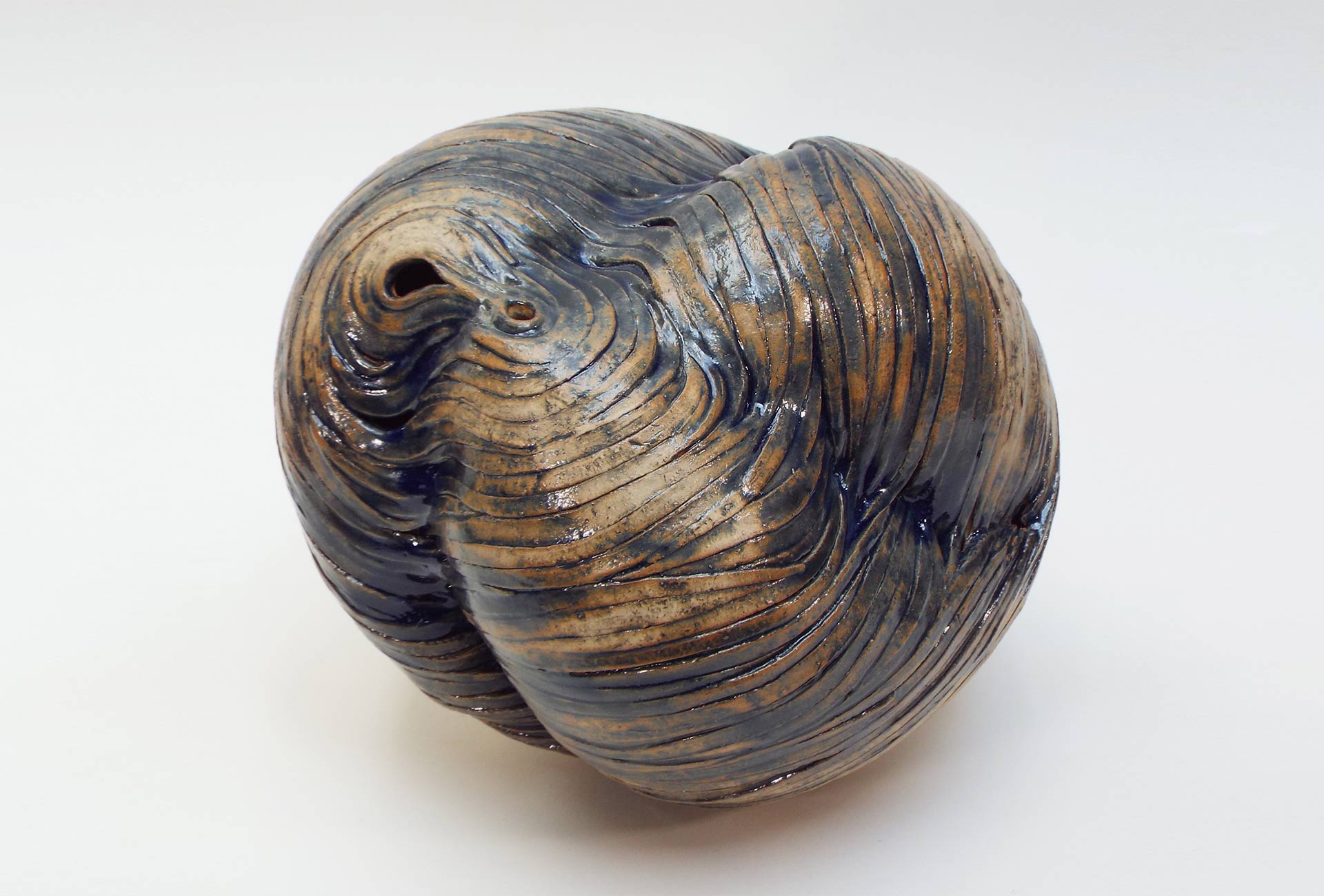
Gudrun Petzold, Blue Fossil, 2026, 30.5 x 31.5 cm.
Gudrun Petzold has named her rotating bodies with softly flowing, dynamic forms “fossils.” Their dark, glossy glaze, openwork yet forming a whole, evokes an origin in deep waters and a former life.
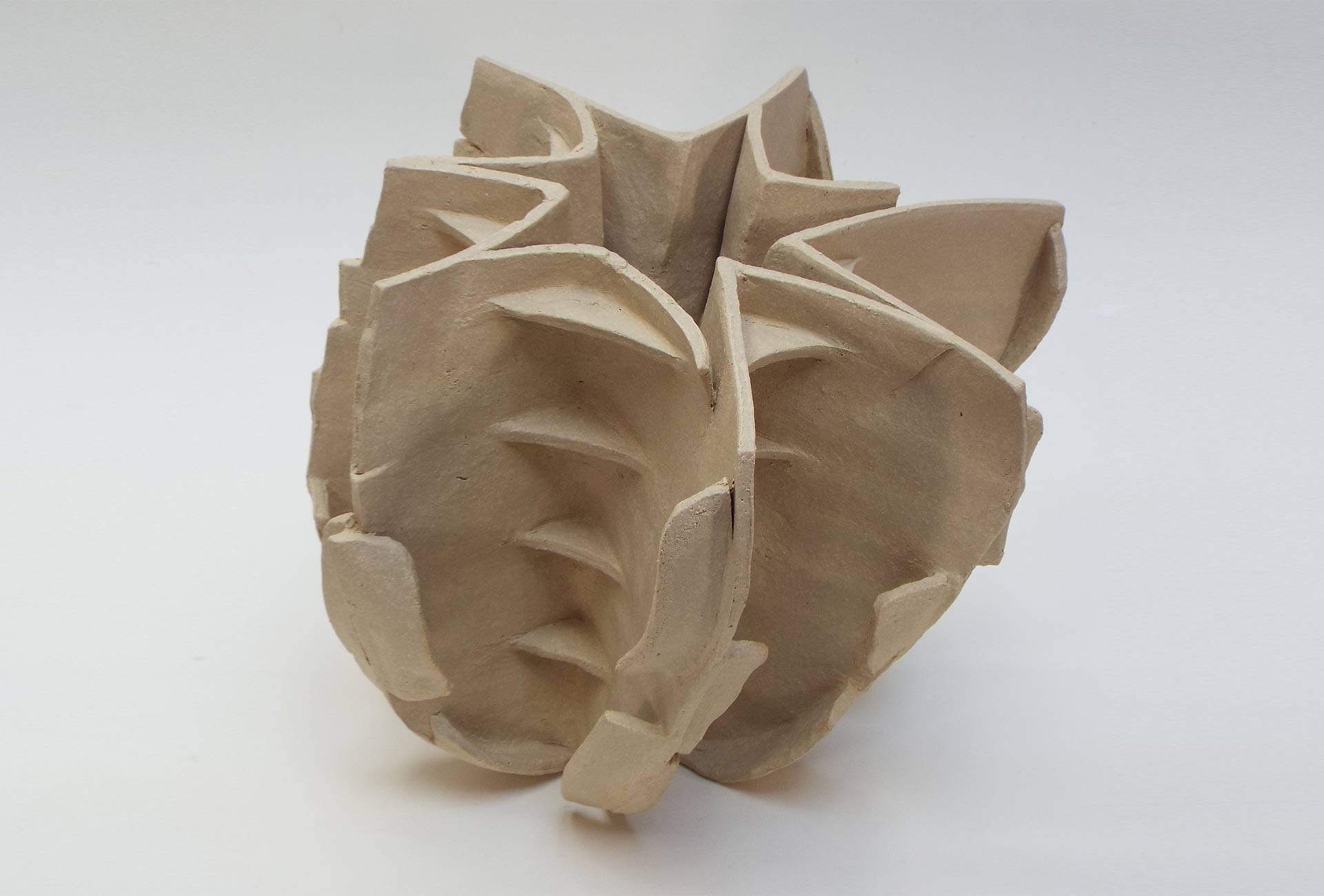
Gudrun Petzold, Capsule Skeleton, 2026.
The interplay with the surrounding space is most evident in the brittle, rigid capsule skeletons. Yet here, too, the static form refers to preceding stages that had to be traversed before the capsule, torn open or shredded, remains as a skeleton and new life can emerge. In the fragmentary, interpenetrating forms, inside and outside are almost suspended. It is about fragmentary legacies, about found objects whose origin is uncertain.
In the mid-1980s, while still living in Berlin, W. Jo Brunner filmed the mountain scenery in the Valais Alps with a Super 8 camera mounted on a tripod, capturing the constant alternation of fog, dark “valleys,” sunny grassy slopes, and rock fragments. These elemental experiences served as the basis for gray-white images (dispersion on linen) in the format 180 x 170 cm. Years later, the artist revisited this theme in oil on cotton canvas in the format 120 x 100 cm.
The paintings increasingly engage with the fundamental changes in the mountain world, triggered by erosion and glacial melt, which can unfold over millions of years but also occur eruptively. Changing weather conditions, approaching fields of fog that gradually or rapidly conceal or reveal rock massifs, bring an additional temporal dimension and different impressions to the pictorial world. For the first time since the large-format gray-white works were exhibited at the Neuer Berliner Kunstverein (1984), two of these paintings will once again be on view in Schöningen.
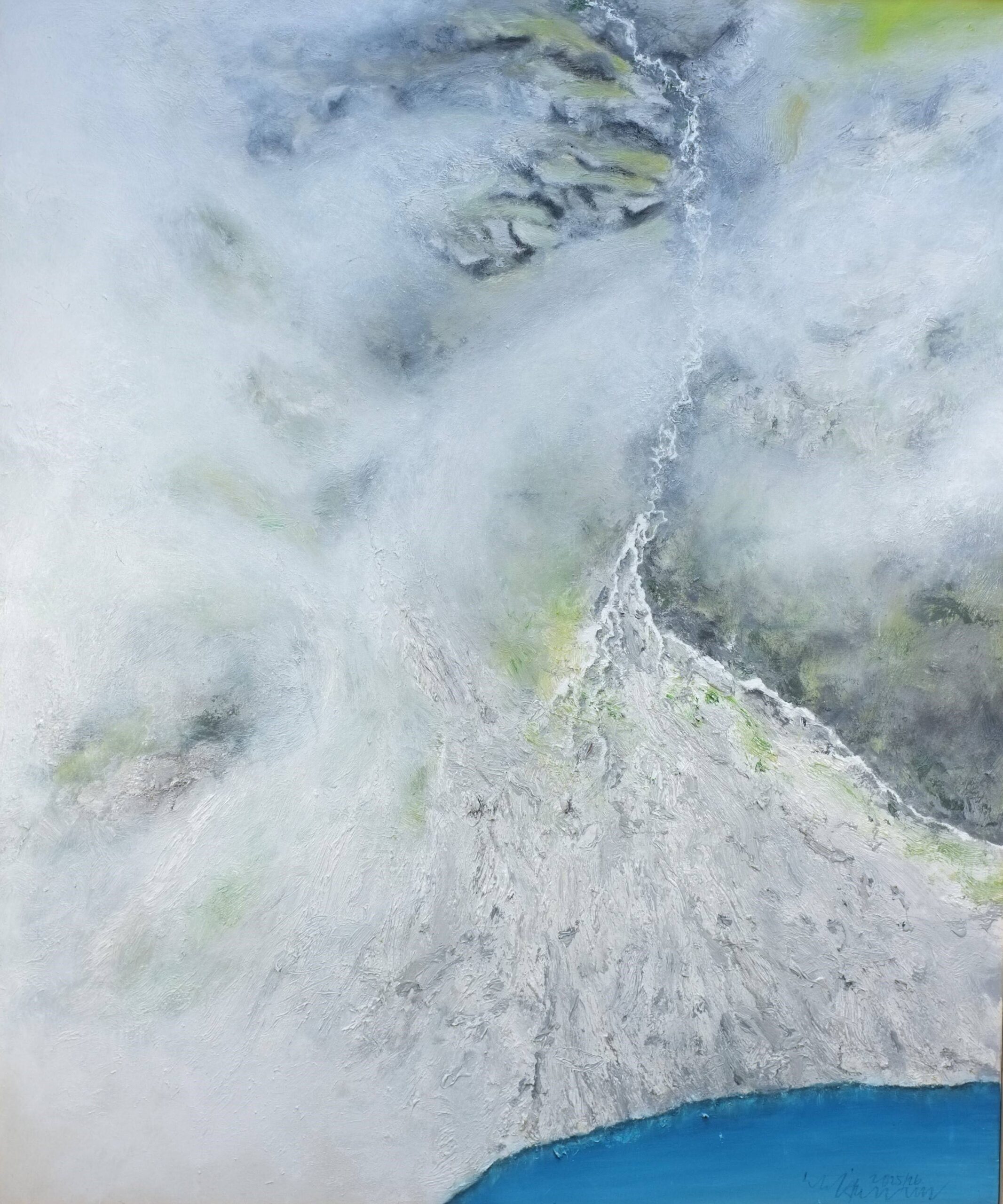
W. Jo Brunner, Lac de Moiry, 2026, 120 x 100 cm.
No less important to W. Jo Brunner are the informal, smaller-format works on paper, created using mixed media—oil, chalk, colored pencils, and graphite—which are always produced in parallel with the large-scale paintings.
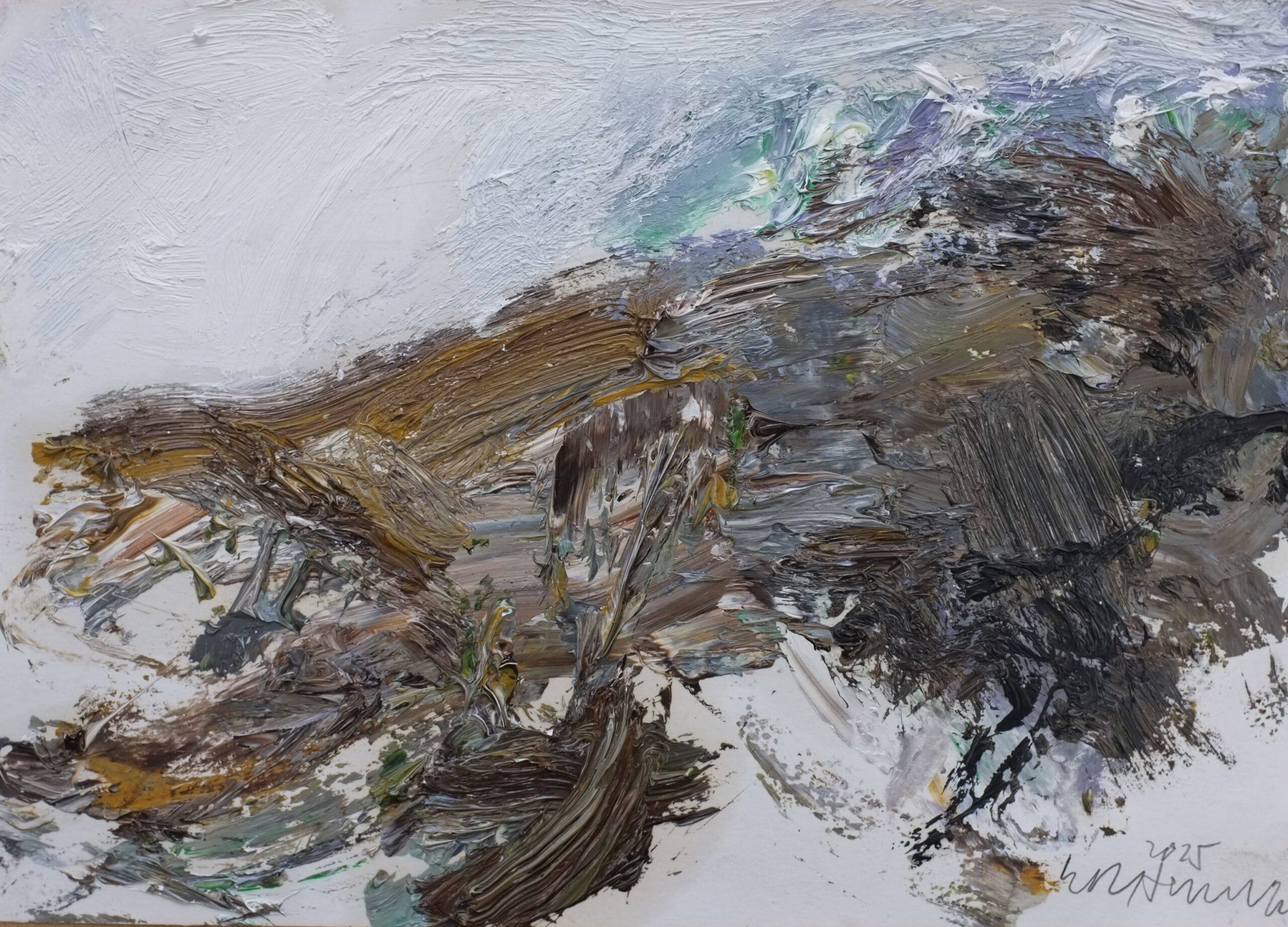
W. Jo Brunner, Ostabsturz, 2025, 21 x 29,7 cm.
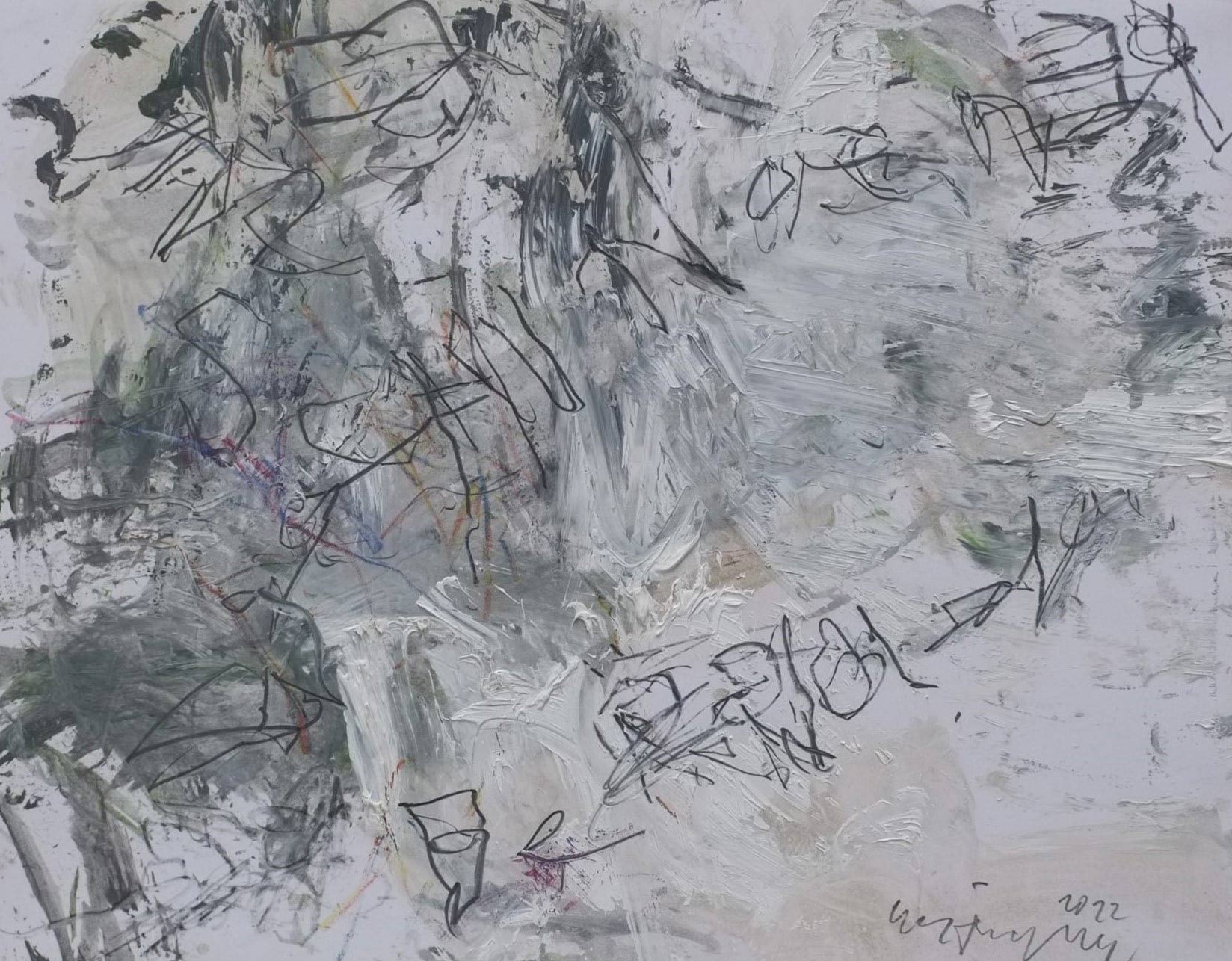
W. Jo Brunner, Geschundener Bergwald, 2022, 24 x 30 cm.
In her text “Gratwanderung,” Elfi Kreis wrote: “The mountain calls, and W. Jo Brunner responds with the multi-layered and powerful echo of his painting, which oscillates between figuration and abstraction, concrete perception and emotional association. In doing so, he oscillates between his very own and highly distinctive path of a ‘more representational abstraction’ (Brunner), which he explores in his series Bilder aus den Bergen, and the free gesturalism of his series Begehung im Val Bondasca – von Bondo bis Sasc Furä, as well as Voglio vedere le mie montagne (Encounter with Giovanni Segantini) – close to Informel.”
- —
-
Kunstförderverein Bildende Kunst Schöningen e.V.
Galerieraum
Brauhof 12
D-38368 Schöningen, Germany - Link